
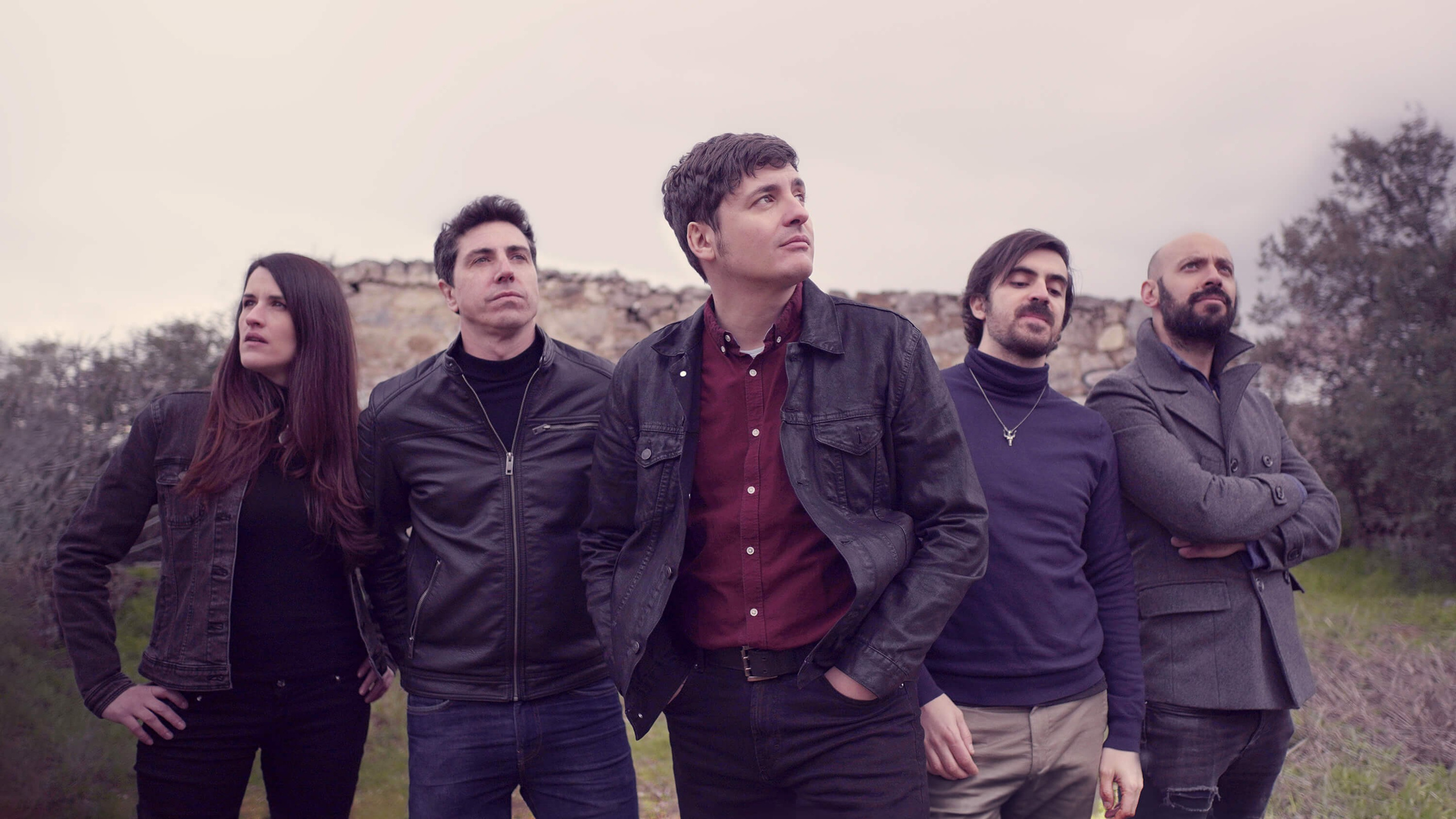
Sweet Q: “Que solo nos quede ganar” is not just a phrase — it’s a way of being in the world

From their early steps with the EPs La Gran Revolución and La Nueva Era to the consolidation of their sound on the album Que solo nos quede ganar, Sweet Q have built a universe where energy coexists with emotion, and the festive blends with the intimate. The Madrid-based band has managed to grow without losing the direct pulse that connects them to their audience, refining their identity without diluting what truly matters.
In this conversation, the group reflects on their evolution, the small “happy accidents” that end up defining a song, the influence of everyday life in Spain, and the strange feeling of hearing thousands of people sing something that was once created almost in secret. An honest portrait of a band that understands music as impulse, risk, and celebration.
If the sound of Sweet Q were a color, a shape, and a texture, what would it be?
The truth is, there probably isn’t a single answer to that question. Depending on the moment and the song, the color might sometimes be an orange leaning toward red: pure energy, emotion, and that urge to live that just can’t wait. The shape might be a wavy line, like a winding road moving toward a horizon that keeps getting closer and closer. And the texture? Maybe rough, with the imperfections we find in our own way of being. But as I said before, depending on the song you’re listening to, at other times it could just as easily be like a dark blue velvet blanket, wrapping around you and making you feel at ease… it depends.
From your first EPs to this album, what has changed and what is still there?
Above all, confidence. On La Gran Revolución and La Nueva Era we had a strong urgency to let everything out; now we trust more in knowing when to hold back and when to push forward. We’ve learned to let the songs breathe, to allow the instruments to find their place within each track without stepping on each other. What hasn’t changed is our determination to make songs that can stir something deep within the people who listen to them, that they can relate to the messages, that the music moves them. Ultimately, it’s about taking great care with the lyrics and every small arrangement until it sounds complete to our ears. In the end, everything adds up.
Do you speak to a “character” in your lyrics, or does each song invent its own?
Each song ends up creating its own character, but they all start from the same impulse: someone making a decision in real time. We don’t usually write from a distance, but from the “now” — from doubt, desire, or the urge to move forward even when you don’t have all the answers.
How does everyday life in Spain influence your music?
It influences everything: the rhythm, the way we speak, and that very Spanish way of saying deep things without becoming overly intense. A clear example is “Lo siento, pero no, ” which is a direct critique of the intolerance you see so much on the streets right now. We like to mix intensity with the everyday, like a conversation at three in the morning after a party.
Would you replace any song on the album with something you haven’t recorded yet?
The truth is, we love how the album turned out and we wouldn’t remove anything. We like leaving that door open to what we still don’t know how to do yet — like a song that captures the relief you feel once the storm of the release has passed and you can look back calmly.
Is there any unusual sound or instrument you’d like to try?
We’re drawn to everyday sounds: a knock, a breath, street noise, a heartbeat… We often try to incorporate those kinds of sounds into our tracks, but always subtly. As for instruments, Curro, our bassist, is probably the one who enjoys experimenting and exploring different sounds the most. In the end, if we like something, we usually end up incorporating it into the songs naturally.
Has any audience reaction ever caught you off guard?
Seeing people shout lyrics that we recorded almost “in passing” or during very intimate moments. That’s when you realize the song is no longer what you originally conceived — it becomes something more. It can transmit a different feeling to each person and serve a different purpose in their life. Discovering those new meanings is what surprises us the most, mainly because we hadn’t considered that there could be so many and such varied interpretations. A clear example is “No habría sido así, ” a festive, fun track… and yes, the lyrics are about someone who has always been stuck in the friendzone, secretly in love with someone they didn’t believe reciprocated their feelings — something very common that could happen to anyone. Many people identify with that role, but one follower told us that the character in the song actually generated rejection rather than empathy in her, precisely because of her own personal experience. These individual perceptions of the songs always catch our attention.
If you were a work of art, what objects would represent you?
It would be something abstract where everything fits together: a flickering neon sign (energy and light that come and go), a clock without hands (to represent the timelessness of the songs), and a half-open door inviting you into a room filled with all the elements we use when creating songs: pens, notebooks, guitar picks, drumsticks, etc.
What would be the ideal ritual for listening to your new album?
A nighttime walk with headphones on, without looking at your phone, through streets you know by heart but that at that hour feel like a different setting. Being alone, yet feeling accompanied by the music, enjoying yourself and allowing a smile to appear.
How do you maintain your essence amid so much change in the industry?
We adapt to whatever is necessary for the music to reach people, but we don’t modify what is essential — what gives meaning to the project. It’s not enough for us to do just anything; we take as much time as needed so that when you listen to one of our songs, you can say: this is Sweet Q. Obviously, we do what we know how to do in the best possible way without turning away from our influences — they’re always there — but you have to find your place without trying to be the most innovative or adapting to every trend. In the end, it’s about being yourself.
Any curious anecdote from the recording process?
There are always “happy accidents.” Sometimes a take that wasn’t perfect, an entrance that was slightly late, a riff invented on the spot, or a voice with less filtering ends up becoming the defining feature of the song without anyone planning it — and that happens in the moment. For example, during the recording of “No habría sido así, ” from one day to the next Curro showed up with an incredibly raspy voice because he had caught a cold and still had to record the backing vocals. That’s why that chorus has so much power.
If you could freeze one moment of the band in a photo, which would it be?
In any dressing room, five minutes before going on stage. You’d see us talking through nerves and laughter, half-illuminated by the contrast of lights before jumping onto the stage. The moment when everything is about to begin.
What do you want people to take away from “Que solo nos quede ganar”?
We want them to feel like winners. We want the album to give them that push to trust themselves even more: even if things don’t work out at first, you have to keep trying again and again. The mere fact of being able to make decisions is already a victory. We want them to dare to chase their dreams without waiting for the perfect moment, because we never know when it will arrive — or if it will arrive at all. That’s the feeling we hope people experience once they listen to the album: a contained euphoria and a sense of well-being that encourages you to face and achieve whatever you long for. The title says it clearly. Let all that remains for us be to win.
Interview: Andrei Lukovnikov


