

Mala Hierba: music as a way out, a dream that keeps insisting, and the permanent struggle to be heard
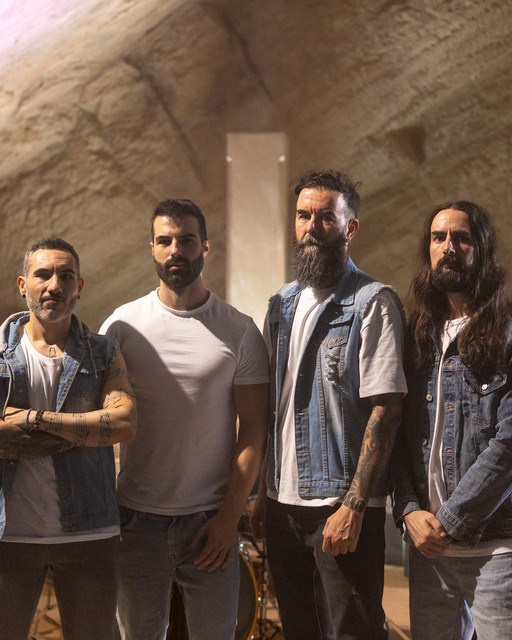
Mala Hierba do not belong to the category of bands that try to define themselves through labels. Their music is born rather from a vital necessity: to break routine, to open a crack in everyday life and turn it into song. From Mallorca, the band have been building a distinct voice within Spanish rock, shaped by introspection, conviction, and a constant struggle to be heard without giving up honesty.
With albums like La insistencia del sueño herido and the recent single Mi pecho rasgaré, Mala Hierba continue to explore a territory where songs are not forced into shape but allowed to lead the way until they find their exact form. In this conversation, they talk about the impulse that gave birth to the band, their personal and collective evolution, the invisible conflicts of studio work, and the real weight songs acquire once they belong to the audience.
If we imagine Mala Hierba not as a band, but as a state that appears at a specific moment in a person’s life, when does that state arise, and what would need to happen for it to disappear?
Mala Hierba was born as a need to open ourselves to an artistic restlessness that we otherwise do not express in our day-to-day activities. It is that escape route our bodies were asking for in order to break routines and do something that made us feel special. What would have to happen for that state to disappear from our lives would be… that we stopped having a life.
At the beginning of your journey, your songs sounded like an urgent need to be heard. When did you first feel that you no longer had to prove your right to have a voice, and how did that change reflect in your music?
Honestly, we do not believe that moment has arrived yet. Managing to be heard is still a permanent and very present battle for us. We know there are many people we have not yet reached, and we do not consider our right to have a voice to be consolidated. In any case, even if that day were to arrive, we are certain that this change would not be reflected in our music, because we feel very identified both with what we do and with the way we approach the entire composition process.
The title La insistencia del sueño herido sounds like an inner wound that refuses to fall silent. What exactly was insisting inside you at that time, and what did you resist for the longest before accepting it?
Our dream continues to be achieving unanimous respect within the world of rock and for Mala Hierba to be a name that opens any door. In line with what we mentioned in the previous question, we are still in that struggle, and the dream continues to insist on being fulfilled.
The new single Mi pecho rasgaré sounds almost like a physical gesture — direct and unprotected. At what point did you know this song had to be that way, without layers or distance? What was more difficult: writing it or deciding to release it?
When we start working on a song, we begin with the skeleton — the lyrics and the melody — and from there we see where it takes us as we play and interpret it. Naturally, each song asks for a different degree of sobriety or complexity, and that is not something we intentionally seek. There is simply a point at which we feel the song is finished, and sometimes that happens with very few ornaments, and sometimes it happens after many layers and a lot of instrumentation.
Has it ever happened that a song starts taking the band to a place you did not expect? If so, which song would you say has been the most “untamed” in your career?
This question is also connected to the previous one. There are songs that, when we first start working on them, we believe we can give a specific feel, and as we build them we realise that the initial idea does not fit the melody or the lyrics, and we have to let ourselves be guided more by what the song is asking for. This happened, for example, with Con la vista en tus rodillas, which at first we wanted to give a harder, more rhythmic feel, and after failing to make the pieces fit, we finally saw that it wanted to be a melodic song.
Spain often does not appear in music in a literal way, but rather as an inner climate. When did you most clearly feel that the Spanish context — social, emotional, street-level — stopped being a background and became part of your sound?
Our songs tend to be quite introspective, with a self-reflective or emotional point of view. If they are in some way imbued with the social context, it is something we are not consciously aware of and, in any case, happens unintentionally.
If we look at your discography as the journey of a single character, what has that character learned over time, and which traits has it failed to change despite the years?
We could not say that the character has learned not to trip over the same stone more than once, but it has learned not to trip over it more than twice. It is a character with firm convictions, who believes in what it does and only changes course when something is clearly impossible to make work the way it has until that moment.
Tell us about a moment in the studio when something went wrong or deviated from the plan, but ended up defining the character of a song or even an entire album.
Something that deviated from the plan was the choice of singles from our latest album. We had already decided which ones they would be and which would have music videos, but during the recording process our producer convinced us that Os cedo los estribos, which was not going to be a single, was a song that really worked well. We ended up releasing it as a single with a video. It defined the album as a whole because it became the first single — the song that opened everything.
Do you have your own definition of where honesty ends and repetition begins? How do you perceive that boundary within the band?
We constantly try to avoid falling into repetitive patterns and make a strong effort not to use in new songs resources we have already used before. From there, we feel very calm knowing that what we do is honestly the best we can offer.
The music industry increasingly demands immediacy and constant presence. How do you protect the space of silence, doubt, and waiting without which it is, in essence, impossible to truly compose?
It is almost impossible to protect it unless one has a very consolidated career and can afford to have no sense of urgency at all. What we do try to do is find a balance between what we want to do and what the industry and the audience demand from us. Above all, we aim not to show the world anything that we do not consider finished, regardless of how long it may take.
Has it ever happened that a story a listener shared with you about one of your songs turned out to be deeper or more painful than the original intention with which you wrote it? Does that kind of encounter change your relationship with your own lyrics?
Yes, it has happened, and it is something we are proud of. What is beautiful about songs is not only what they tell, but that the person who receives them can make them their own and find moments of their own life in them. That leads us to feel greater respect for our lyrics, because we know they are no longer only important to us, but also to others.
What has been the most important conversation about Mala Hierba that did not happen on stage or in the studio, but somewhere in between — on the road, between concerts, or even in silence?
There have been many, especially those that shaped the current situation and line-up of the band. Probably the most important conversations have been related to that — facing line-up changes has always been a challenge for us.
Photos and videos from concerts often capture the climax, but not the exhaustion. Are there images from backstage or the road that feel much more honest to you than the stage, but that you might never show publicly?
We are lucky to have our photographer and friend, Tomàs Moyà, who always has his camera raised. He has captured many moments of that kind that we would never publish, mostly for comedic reasons. What happens behind the scenes is better left there…
And finally, if instead of a message or advice you could leave our readers with a feeling to carry them through the coming year, what would it be and why?
On a musical level, we would try to convey the feeling that everything is very much alive, and that at any moment they have the opportunity to immerse themselves in that atmosphere, whether live or at home. On every other level… everyone for themselves.
Interview: Andrei Lukovnikov


