DURA•CALĀ: “We don’t write music to please the algorithm — we write it so we don’t betray ourselves”
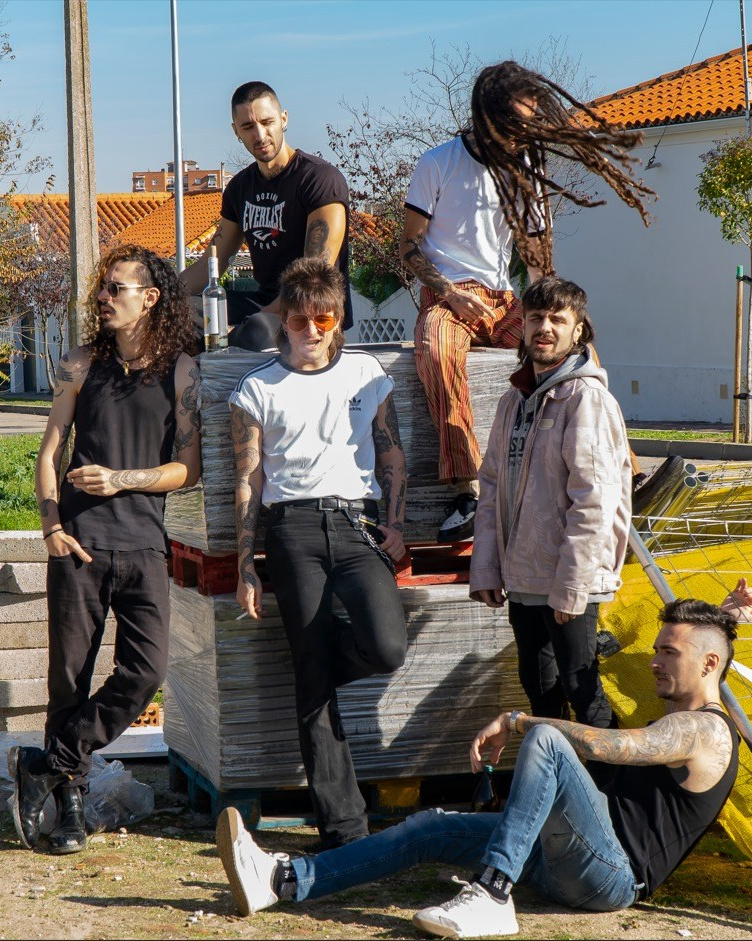
Some bands are born from strategy, others from necessity. DURA•CALĀ clearly belong to the latter. Based in Madrid, the project has taken shape somewhere between macarreo, rock, rumba and a deeply honest attitude toward music and the reality surrounding it. They define it themselves as “macarreo madrileño” — a label that is both flexible and necessary to describe a sound that deliberately avoids comfort and predictability.
With their debut album ¡AY! out now and singles like “Reyerta” and “La Suerte” shaping their identity, the band moves between celebration and fracture, between the neighborhood and reflection, without asking for permission or looking for shortcuts. In this conversation, DURA•CALĀ talk about Madrid as both love and condemnation, Lorca as a living reference, the music industry, creative honesty, and why they prefer slow, organic growth over inflated numbers.
This is DURA•CALĀ, in their own words.
You call your music “macarreo madrileño, ” but if we think of it not as a style but as a living organism: what is growing in it right now, what is fading away, and what do you consciously avoid letting become too comfortable or predictable?
The term came from the need to give a name to a style that wasn’t easy for us to describe. All new bands face the same question: “What kind of music do you play?” There’s a lot of mixture in Dura Calá, and part of the point of the project was to do something that felt like ours, without the intention of labeling ourselves. So what we felt defined us most was macarreo. Every day we feel more confident exploring this approach, and we’ve stopped trying to define ourselves, because there’s such an amalgam of references that if we named just one style, we’d be lying. We avoid predictability so we don’t get bored. We’ve spent a long time playing other people’s songs — this project is about doing our own thing, and if it sounded like someone else, it wouldn’t be ours.
In “Reyerta” you engage in dialogue with Lorca not as a museum piece, but as someone alive. What is it about his way of understanding tragedy, honor, and destiny that feels especially close to you in today’s Spain?
Lorca is a reference for us. The bravery with which he told his stories, and the stories of those who were left out of the official narrative, feels very rock and roll to us. He spoke about desire, violence, and discrimination without asking for permission and without fear of the consequences. Topics that, surprisingly, are still uncomfortable for many people. There are still people whose lives are conditioned by who they are or where they come from. The concept of honor is dangerous. It can be something very noble, or it can push people to justify atrocities. We’ve made a lot of progress, but the movie is still the same.
Over time, the idea of freedom tends to change for any musician. When did you realize that creative freedom is not the absence of limits, but the ability to choose your own?
We don’t think it’s about setting limits, but about being faithful to intuition and to your own criteria. When you trust that, everything flows. For us, creative freedom has more to do with not betraying yourself than with thinking about boundaries.
Many characters appear in your songs — rough, fragile, contradictory. Is there one in particular in whom it’s hardest for you to recognize yourselves, and why?
Our songs deal with our own stories, and the characters that appear are nothing more than reflections of ourselves. I don’t think it’s hard for us to recognize ourselves; at most, some of those characters may represent moments from the past that we no longer feel so close to.
Your music moves between celebration and fracture. How do you sense the point at which partying stops being honest and pain stops being fertile for creation?
That’s life itself, right? Great moments and fucked-up moments. Either you move through all of it or you fall apart. Creating allows us to analyze it and release what we need to release instead of avoiding it. As for the honesty of the party, we’re no one to judge. Whether it’s a party to enjoy or a party to escape, everyone manages it the way they know how — or the way they can.
Madrid is not just a place for you. Was there a moment when the city disappointed you or even pushed you out, and how did that affect your songs and the way you exist in the world?
Our relationship with Madrid, like that of most people who live here, is love/hate. It’s given us everything and taken everything away. A city of possibilities, welcoming and frenetic, but also cruel and inconsiderate. You arrive chasing a dream and end up trapped in a loop, fighting to survive and stay afloat, with no time for anything other than spending a shitty salary on a tiny room where you sleep five hours just to go back to work and earn a few lousy euros. Depending on the day, we’re on one side or the other.
During the making of ¡AY! there must have been difficult decisions. What did you have to give up — an idea, a sound, or even ego — to protect the coherence of the album?
The songs on the album are the ones that made it through the selection process. Many demos stayed in the drawer because they didn’t measure up. We love some of them, but we prioritized putting out a coherent record over satisfying a whim. There will be time to work on them and maybe release them later.
“La Suerte” sounds like a direct conversation with fate, without romanticism. When did you know this song had to be this raw, and what does it say about your current moment as a band?
“La Suerte” is possibly one of the songs that’s most honest about the moment in which it was written. We had arrived at a sound, at a concept — now all we needed was a bit of luck for everything to go well. The message was clear and direct enough, and we didn’t think it needed any more embellishment. And here we are, still waiting for luck, to see if it finally decides to show up.
Spain is a mosaic of identities. If DURA•CALĀ had been born in Galicia, Andalusia, or the Basque Country, what would change radically in your music and what would remain intact?
Well, it would be Galician macarreo, Andalusian macarreo, or Basque macarreo. The demonym would change, but the macarreo would remain intact.
Every artist carries stories that never become songs. Do you have one that stayed out for being too personal, too harsh, or too alive?
We have quite a few, of course — but if we don’t want trouble with the Guardia Civil, sadly we can’t tell them here.
Have you ever experienced a concert where the audience’s reaction completely transformed a song, to the point that it was never the same for you again?
We’ll never forget our first show. Some people were left outside because the venue filled up, and the people inside were singing the songs. Songs that hadn’t even been released — we were blown away. It seems that promoting the project in Madrid’s after-hours spots actually worked. We couldn’t point to one specific song, but from that moment on, we felt even more attached to the entire repertoire.
Today’s industry demands speed and constant presence. What do you think gets lost in this endless race of releases, and what do you deliberately choose to do more slowly than the rules suggest?
Sometimes there’s no choice but to jump through hoops, especially when it comes to promotion as a new band with no resources. You lose a bit of shame by acting like a clown on social media (although, truth be told, that already came pretty naturally to us). What we absolutely don’t want to do is pay for exposure or inflated numbers. We prefer to watch the project grow organically and for our numbers to reflect reality — otherwise, surprises come later.
If you were offered the chance to create a project that doesn’t fit algorithms, playlists, or commercial expectations, but is absolutely honest — what would it look like?
That’s exactly what we’re doing. We don’t compose thinking about pleasing the algorithm or getting into playlists. We want to do our thing, our way. If that later ends up in a playlist or someone sees commercial potential in it (and we can make some money), then great.
Looking back at your journey, are you today who you dreamed of being at the beginning, or someone completely different — and perhaps more real?
We’ve just started with Dura Calá. Separately, we’ve spent many years in the music world, but this project has just been born, so for now we’re exactly where we want to be. Being ourselves, because we don’t know how to be any other way.
To close: if someone discovers your music at a decisive moment in their life, what inner movement would you like to provoke in them — not an emotion, but an action?
Honestly, we do this for ourselves. If someone listens to us and feels identified, that’s fucking amazing. Telling our stories helps us, and if it helps someone else find themselves in them, we’re more than happy. There’s no greater intention beyond that, really. But if someone ends up feeling through our music what we feel through the music that fills us, that’s an achievement unlocked.
Interview: Andrey Lukovnikov
Photo: Angel Muñoz