

D’Baldomeros: “Granada runs on musical endogamy by default”
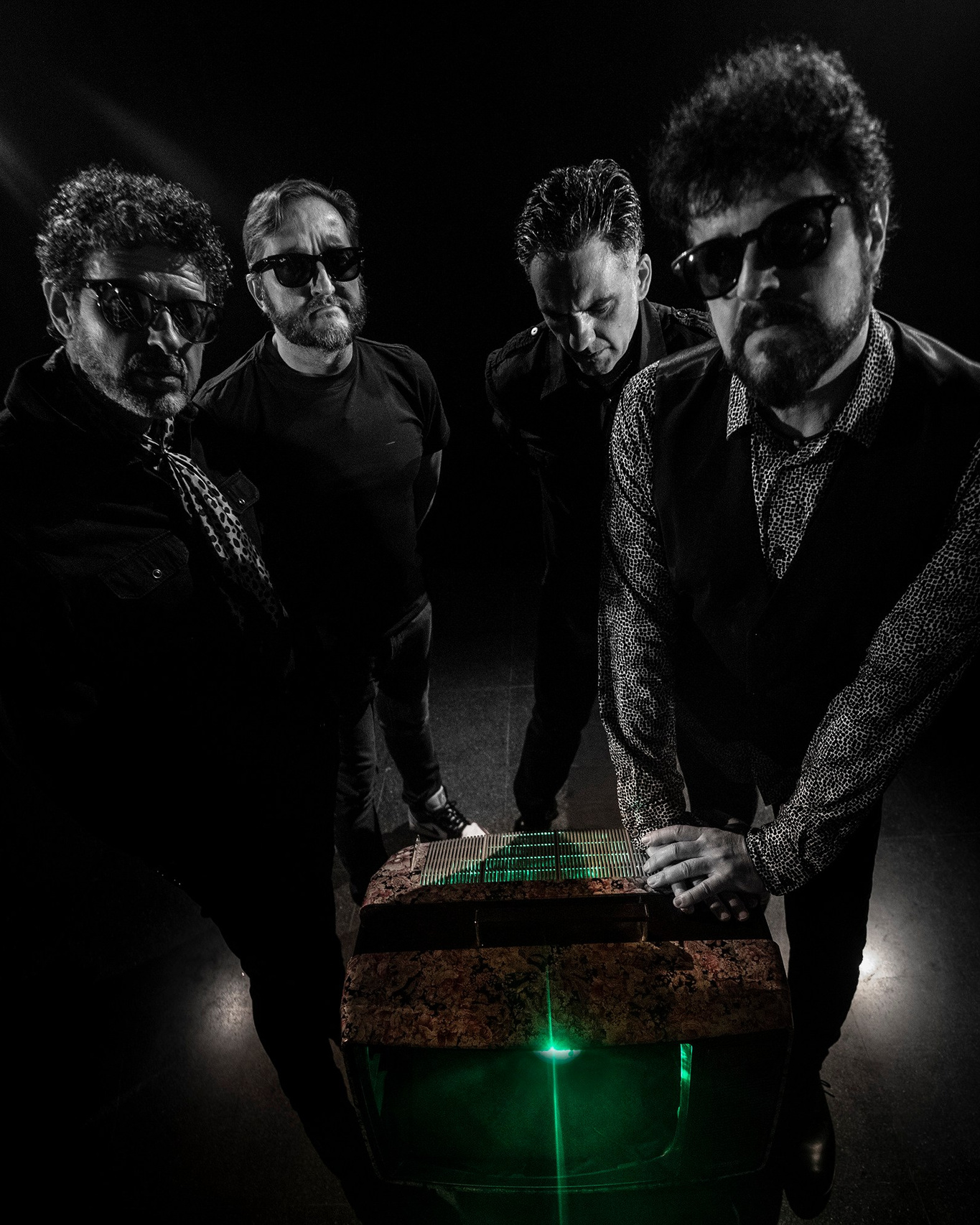
Some bands exist to fill calendars. Others exist because they have no other choice. D’Baldomeros, a quartet from Granada formed in 2015, clearly belong to the second category. Ten years on the road, three albums, dozens of festivals, and a sound that crosses electro-rock with funk and disco without asking anyone’s permission. In 2026, with their third LP released yesterday, the band reaches the most honest moment of its career.
The timing of this conversation couldn’t be more fitting: “Gran Derroche”, their latest single, captures exactly what they are — urgency, contained energy, the feeling that time is running out and you’d better squeeze every last drop before dawn. Eduardo García (vocals, guitar and programming), Paco Romero (drums), Rafa Martín (bass) and Peter Velardo (guitar) have spent a decade building something that doesn’t fit in any box — and according to them, that’s exactly what they were after.
We talked about dogs, farmhouses, musicians who leave and those who stay, Granada as a springboard and as a labyrinth, and why AI doesn’t know what real feedback sounds like.
The band is named after a dog — and that already says something about how you relate to ego and not taking yourselves too seriously. Was that a conscious choice from the beginning, or did it just happen?
In this case, it was a heartfelt tribute to a beloved creature, nothing more. Our intention was more about making songs than entering that mystical universe that some bands seek when choosing a name.
La Vida en una Hora was recorded in a farmhouse with views of the Sierra Nevada, with Harry Up! as producer. That sounds more like a spiritual retreat than a recording session. How was it really? Was there something deliberate in isolating yourselves to make the album?
As an artistic experience it was fantastic — we became more of a commune, not just recording in the middle of the Lecrín Valley, but also cooking and doing other things together when we weren’t in the studio. We had a brilliant time, and working with Iván was a fantastic experience.
Between “Bailas” and “Masa Crítica” there are two years and an enormous shift in tone. “Masa Crítica” is a direct statement, no ambiguity. Where did that need to speak so plainly come from? What happened in that time?
Beyond the production itself, we were at a point where we had parted ways with a musician who created more problems than joy. It was the definitive reset that allowed us to establish the current lineup and consolidate the sonic identity I always wanted for this band.
“Peculiares” and suddenly Noni from Lori Meyers. When you have such a defined sound, bringing in an outside voice isn’t a decision you take lightly. How did that come about?
One of life’s coincidences — I started working as a runner with Lori, and from there I asked Noni if he’d be up for collaborating with us, just as we’d done with Juan Alberto Mutante on “Masa Crítica”. He happily agreed; he liked the song and wanted to add his voice. For us, it was a real luxury to count on two musicians who have contributed generational anthems to Spanish music — and fellow Granadans at that.
Ten years. You started as three, then four, with lineup changes along the way. What has broken in the way you understand music since then? And what, perhaps, has been fixed?
Not much has broken — maybe the time we lost with people who didn’t contribute enough. What we’ve gained is knowing what we want to do and where we’re heading together, and of course not making the same mistakes with personnel again.
You exist in a space that’s hard to label — not pop, not hard rock, something in between. Have you ever felt that as a real problem? Or more as freedom?
For us it’s something we nurture with great care and affection, trying never to stray from our sound — always combined, never leaning too far in one direction. In the end, bands that find their sound do so because they believe in it and see no problem defending it.
Granada Sound, Fortaleza Sound, Primera Fila Fest — you’ve been a reference band in Granada for years. Is your home city a springboard or a ceiling? Do you sometimes feel that being so well known there becomes a weight?
Honestly, we can’t speak badly of our city, but our sights are set on moving the project beyond Granada’s circuit, which can be complex and frustrating at times — this city runs on musical endogamy by default.
There are songs that carry a story inside that no one outside hears. One you’ve never told publicly. What’s yours?
Ours is about a bunch of guys who enjoy making songs without any pretensions. Time waits for no one, and we believe that being real and honest is the best story we can tell about ourselves.
In 2026 you’ll release your third LP, ten years after the first demo. It’s a long road to something this significant. Why now? What has changed in you or in what you want to say?
Without a doubt it’s the most personal and truthful we’ve been throughout this time. Right now is when the proposal for this record feels most real and honest — with genuine songs that reflect the most creative side of what we do, a place where we feel very at ease.
A specific moment on stage — not the biggest or most successful, but the one where you felt that what you do truly works. Not in career terms: in terms of connection with the people in front of you. Which one was it?
In every space, every moment we perform — even if it’s fleeting — there’s always that point of feedback that makes you think we’re not entirely wrong. When someone sings along, jumps, or vibrates in their own way with our songs.
AI tools are everywhere now. I’m not going to ask if you’re for or against — that’s boring. What I want to know is this: what specific part of what you do has already changed — or could change — because of AI? And does that make you happy?
What is AI? We’re analogue — valve and solid state, the beat in the chest, the feedback that cuts through your soul. AI does and will do wonderful things, but not those ones. Not yet.
The “Peculiares” video is almost a road movie. Do you have a clear idea of how your world should look from the outside — in videos, in photos? Or is it always a little accidental?
In this case we wanted to capture our time at Fortaleza as a physical and emotional backdrop for the story told in “Peculiares” — the lived experience of the song reflected in the narrative of the video. Our great friends J.M. Reyes and Asún were the protagonists; nobody better than them to bring this peculiar story to life.
Last question — and I’m not going to ask you to say something to the readers, that’s dreadful. Instead: if one of you could write a letter to the band in 2015 — one piece of advice, one warning — what would it say?
It would say… guys, keep believing in what you do, keep it fun always — never lose sight of the fact that this, however long it lasts, has to make you feel good.
Interview: Andrei Lukovnikov


