

DENISDENIS: “Love is the hope we need”
The Cadiz-born band that turns emotion into identity
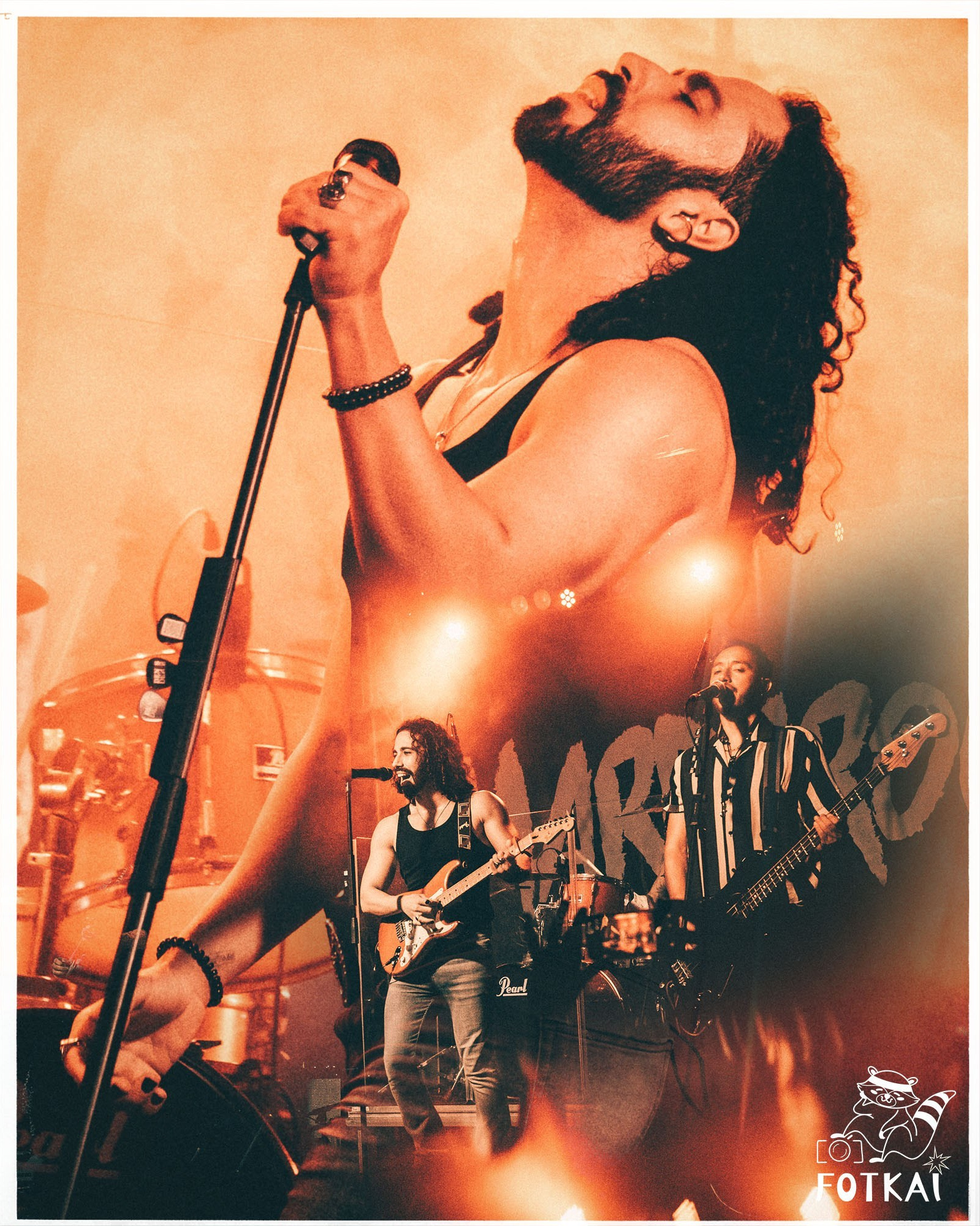
DENISDENIS is one of the most distinctive emerging bands in today’s Spanish music scene. Born in Cádiz during the pandemic and transformed from a home project into a solid four-piece, the group has created its own universe where emotion, poetry and live energy coexist and attract more listeners every day. With songs like “Baile de Almas”, “Nuestra Historia” and their recent collaboration with Embusteros, the band has carved out a place in the national indie landscape and sparked the interest of festivals, critics and audiences.
In this in-depth conversation, the band looks back on its beginnings, the evolution of its sound, the importance of Cádiz in its identity, and the journey that led them to their first full-length album. A sincere, luminous interview full of the intensity that defines a project destined to grow.
When you were working on your first EP El impulso del destino, the project was initially something more personal for Denís before becoming a four-piece. How did the creative process and your internal dynamic change when Manu, Ramón and Germán joined?
In every way. Being a group and having a band broadens both the musical and compositional horizons infinitely. And sharing moments and joys is always more beautiful when done together.
In “Baile de Almas” there is a very strong emotional tension. How did you balance melancholy and hope during the recording, and what personal or collective experiences inspired that duality?
Baile de Almas speaks about the relationship between two people and what it means for us to get up on stage and see everything clearly when people sing our songs. That beautiful sense of communion is the driving force behind the project. Love is the hope we need.
Your lyrics often use metaphors, poetry and philosophical references. Are there literary movements or specific authors you feel are “spiritual co-authors” of your songs?
We like each person to give the song the meaning they want. That’s why we use literary devices, metaphors and poetry—though not in every song. Miguel Hernández, Baudelaire, Rimbaud and Tristan Corbière are some of our go-to writers. Camus and Schopenhauer also resonate in songs like “Las Humedades” or “El Tiempo del Suspiro.”
You’ve mentioned influences from 90s bands (U2, Héroes del Silencio) and from the current indie scene (Izal, Shinova). When you write a new song, how do you decide whether to follow those influences or to experiment with something completely different?
Each song is a world of its own, and we have to leave aside any ego we may have as musicians. If you listen closely, the song speaks to you and tells you whether to go one way or another—whether to add a solo or not; whether to use reverb instead of delay, or add a synth as a pad; whether to use a more “Copeland-like” drum part or simply a four-on-the-floor kick; whether to use more metaphor or write something more direct. Those influences are part of who we are. We also know where we want the project to go. We move between pop, rock and indie, and that’s where the song will live.
You worked with José Caballero at Neo Music Box. Do you remember a specific moment in the studio when you felt your music had truly found its identity?
When we finished recording “Baile de Almas, ” we got emotional. We knew we were creating something special. We cried and hugged. It was the first song we recorded, and we knew that everything we had gone through was worth it in that exact moment. Working with José Caballero was wonderful. At Neo we found the kind of producer we like: someone who speaks clearly, brings ideas, and truly listens. For us, it was the beginning of a relationship with Aranda that became tangible when we played at El Trigo at Sonorama, and it keeps growing. Aranda is our home. We owe it a lot.
Aesthetic choices — not just musical but visual — seem important to your project. In music videos like “Baile de Almas” or “Mi Eternidad” you draw from Andalusian architecture and landscapes. What do you aim to convey with this visual approach?
We want it to make sense with the song and give it a story that’s more visible for the listener. We shot Baile de Almas in Madrid with Jimmy Llamas (Viva Suecia, Pablo Alborán), and it’s still the music video we’re the proudest of. We keep receiving messages from people saying it’s wonderful, and that fills us with joy and satisfaction.
“Nuestra Historia” has been described as having the intensity of 90s stadium rock, and you recorded it in a theatre. How did you conceive its visual universe, and what did it mean to work in such a space?
We were given the chance to shoot at the Teatro de las Cortes in San Fernando, and we didn’t hesitate. It goes hand in hand with the song—powerful and intense, just like what a theatre symbolizes.
Cádiz and Andalusia appear in your imagery and sensibility. How do the nature, history and culture of your homeland influence not only your music, but also your worldview as a group?
In many ways. For us, Cádiz is the most beautiful city in the world, and we feel incredibly lucky to have been born and still live there. Our land inspires us mainly in the lyrics. Musically, in our genre, there aren’t many local references, which forced us to leave to find our place. Being loved and respected in our city is the most wonderful thing we can feel and what we’ve always hoped for.
As your popularity grows, how do you preserve a sense of intimacy and sincerity — even when playing big festivals with high expectations?
We’ve protected our intimacy even before gaining popularity. That part is only ours, and although we sometimes share personal things, we like to separate work from home. It’s important to do so because it gives balance and keeps life healthy outside the music bubble. We come back from a festival and on Sunday we have to do laundry or wash dishes—how could we not separate those worlds?
As for the second part: we grow when there’s more responsibility, more people and higher expectations. We thrive on challenges. We need them and enjoy them.
In your most recent work there’s a clear sense of evolution. What has been the most daring experiment you’ve done — whether in arrangements, lyrics or style — and how did the public react?
Probably moving a little closer to pop while keeping our essence. The result was wonderful and helped us grow as musicians and expand our horizons. Unlike many bands, we don’t mind whether people call us rock, pop or indie. Not even the algorithm really knows. We want creative freedom—within the boundaries we’ve described. That’s why every song on the album represents the project and what DenisDenis aims to bring to the scene.
In your collaboration with Embusteros on “No voy a parar”, you created an anthem of determination. What did that collaboration reveal about your own musical approach and about the way you relate to each other on stage?
It ties into what we said earlier. We realized we could explore more pop-leaning lines without losing the band’s essence, while keeping the strength and power we like in our songs. The collaboration with Embusteros was crucial for us and for the album, and we’re very grateful to Jose for believing in the song long before our tracks gained traction. He was one of our first supporters. We admire him and care for him. Live, it’s probably the song that gets the crowd jumping the most.
Thinking about your debut album, what would be the “message of the soul” you want to convey? What matters or worries you most at this moment?
First and foremost, presenting our proposal clearly, with everything that releasing a debut album represents for a band. It’s an album that symbolizes awakening—the strength that emerges after the night — while dawn represents the virtue of starting again. This duality shapes the spirit of the record and the experience revealed the moment the needle drops on the vinyl or you press “play.” We wanted the title, artwork and songs to form a whole, a statement of intent. It’s a record about transition, about the energy that moves between doubt and light until reaching decision—the true motor of change and progress in our lives.
Denís began recording at home during the quarantine. What was the most unexpected lesson — technical or emotional — you learned then, and how has it influenced the way the group works today?
You can achieve very good results and reach people with a cheap laptop, a beginner’s Squier and an SM58.
That said, we wouldn’t record an entire album at home again. Now that process is for demos. We each send our parts and shape the song based on what we’ve already worked out in rehearsal.
Live shows convey not only music but also a story or full emotion. Is there any on-stage moment that marked you as a group, even if something didn’t go as planned?
Playing at La Plaza del Trigo at Sonorama was our turning point—the push we needed to reach more people. It put us on the map as a band. We owe that beautiful lift-off to Aranda.
Fans are part of your story. How do you react when listeners interpret your lyrics or metaphors in deep or unexpected ways? Is there a song whose audience interpretation surprised you completely?
Very positively. We write this way precisely so that what you described can happen. Once we release a song, it stops being ours and becomes the story of whoever listens to it. “Tártaro” is probably the song from which we’ve received the most interpretations. And meanings change as we grow and add years to our lives. What a song meant two years ago can now mean something else. For us, that mystery is very exciting.
How do you view the current music industry — streaming, social media, festivals? For a young but growing band like yours, what is the biggest challenge and the biggest opportunity?
It’s difficult—but when hasn’t it been? The difference now is that you need extensive knowledge in areas far beyond music itself, but nothing you can’t learn. Today’s musician has to be many things they’re not really being trained for. The industry has changed and we’re in a transition toward a new model. For emerging bands, it’s hard even to play in venues due to the lack of support for genres that aren’t purely mainstream and the general decline in the habit of going out to discover local bands. Venues don’t book bands without a certain background or support, and that creates a loop that’s hard to break.
This also happens in other fields: excessive CV expectations, credentialism, lack of work experience. Today, unless you take your project very seriously and know how to use the tools available, it’s very hard to move forward. Being good at playing isn’t enough.
Do you have songs, versions or musical ideas you don’t release because they’re too personal, raw or vulnerable? Why do you choose to keep them?
There are many songs that, because of style or timing, we don’t feel belong in the set of tracks that can form a coherent album—even if we move within an eclectic mix of pop, rock and indie. “Sin Miedo” is one of those cases. It was written a long time ago and only now made sense to include. It’s a rara avis, because abandoned songs tend to lose their place to new ones written from new life experiences and musical growth gained over the years.
On a personal level: if each of you could invite one musical or philosophical figure — alive or dead — to dinner, who would you choose and what would you like to discuss?
Germán Barbosa: Andrés Cepeda
Manu Porras: Freddie Mercury
Raymon Sánchez: Marcus Aurelius
Denis: I have many, but musically I think I’d choose Chris Cornell.
How do you imagine your creative path in five or even ten years? Is there any unexpected direction you’d like to explore — another genre, an unusual collaboration, an audiovisual project?
To maintain the excitement and work rhythm of recent years, and to be remembered as one of the bands that emerged in the 2020s and left a mark on people’s hearts. The next step is already defined, and we’ll start working on it in January next year.
Looking back from the beginning of the project to today, is there a moment you consider symbolic or almost “mythical” for the band, and one you’ve never shared in an interview?
Not something we’ve never shared, but if we had to choose one moment, it would be an acoustic show we did in Aranda before releasing the singles of our first album. That night changed everything.
How do you value FOTKAI’s approach to creating photographic reports, where attention is given not only to the musicians but also to the audience, atmosphere and live moments? What attracts you most to this format?
It was a joy meeting you and working with you. Your vision, communication, ideas for the photos… it’s something hard to find. And your work shooting and editing them seems wonderful to us. We’re very happy with the result.
Thank you for the space.
DENISDENIS
Denis Vélez — vocals, guitar
Manu Porras — drums, backing vocals
Germán Barbosa — bass, saxophone, backing vocals
Raymon Sánchez — guitar


Photos: Andrey Lukovnikov


